TRANSLATION IN INDONESIAN: The Book Four Turns in Our Existence
Recently the memoirs of my parents, Wim F. Wertheim and Hetty Wertheim-Gijse Weenink, "Four Turns in Our Existence, The Lost Indies, Indonesia Born" (1991), is translated into Indonesian and published by OBOR Publishers in Jakarta: Jakarta, Yayasan Pustaka Obor Indonesia (2025), ISBN: 978-623-321-351-6.
The two forewords, written by Ken Setiawan and Bonnie Triyana respectively, follow below.
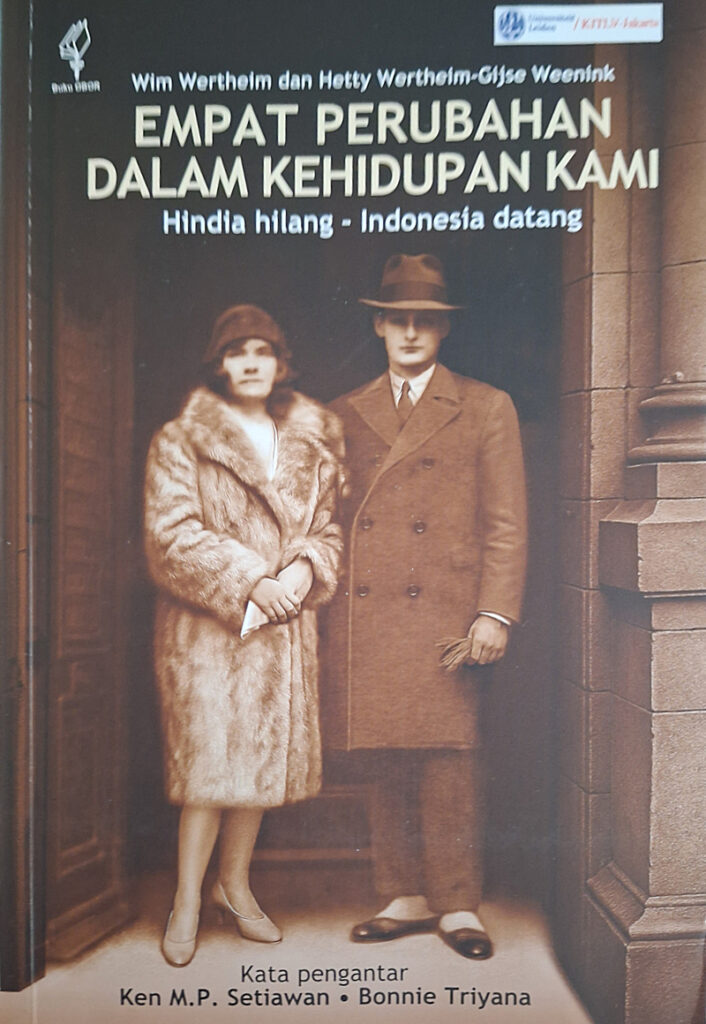
The book Vier Wendingen
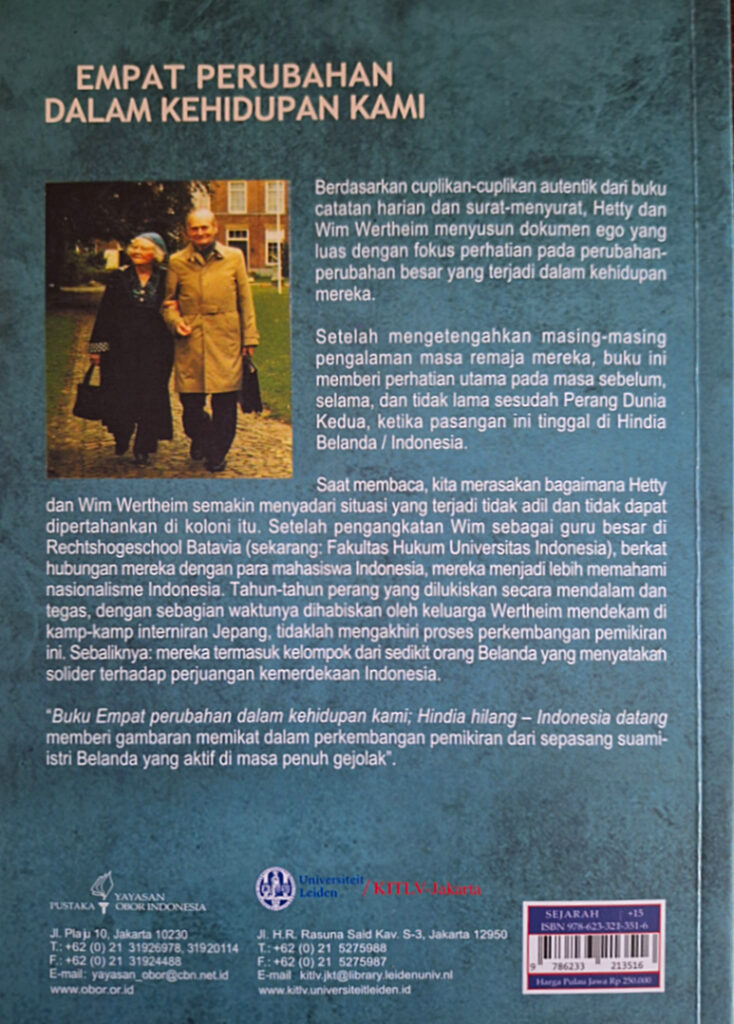
The book Vier Wendingen
Engels Voorwoord voor de Indonesische vertaling van Vier Wendingen in Ons Bestaan: Indië verloren, Indonesië geboren
Ken M.P. Setiawan
The book Vier Wendingen in Ons Bestaan: Indië verloren, Indonesië geboren gives an intimate look into the lives of Wim Wertheim and Hetty Wertheim-Gijse Weenink. Of the four changes that they highlight in this book, three are directly connected to Indonesia: their move to South Sumatra, in which was then known as the Netherlands Indies, followed by the lead-up to and eventual Japanese occupation, and their return, at the end of World War Two, – together with their children – to the Netherlands. These stories are a recollection of deeply personal experiences and simultaneously speak to significant periods in Indonesia’s history, traversing from the late colonial period to the early years of independence. Most importantly, their stories give insights into critical developments in the thinking and approaches of those who were part of the colonial elites, and their growing understanding of, and eventual identification with, the aspirations of the Indonesian nationalist movement. Holding such views both among the colonial elites and in the Netherlands, was highly controversial.
Wim Wertheim was a close friend of my father, Hersri Setiawan. The first time my father met “Oom Wim”, as he called him, was in the 1950s and Wim Wertheim visited Universitas Gadjah Mada, where my father at that time was an undergraduate student and was an editor of the student newspaper. Nonetheless, it was not until the late 1970s that they would meet one another again. By that time, my father had just been released after ten years of imprisonment, including in the penal colony on the island Buru, under the authoritarian New Order regime following the mass violence of 1965-66. At this meeting, Wim Wertheim met with a number of former political prisoners and leftist writers, including Pramoedya Ananta Toer, Bakri Siregar, Hasyim Rahman and Joebar Ayub. Not long after, Wim Wertheim met my father again, asking Hersri to translate his works. Because of this, intensive communication developed between them, which quickly developed in a deep friendship characterised by mutual trust and support, that lasted until Wim Wertheim’s passing.
That Wim Wertheim chose a leftist writer and former political prisoner – a social pariah in Indonesia - to work with him a former political prisoner was not a coincidence. Just as earlier in his life, Wim Wertheim chose to side with the Indonesian nationalist movement, based on a deep sense of justice, he had also been an early, and very vocal, critic of the Suharto regime. In the Netherlands, Wertheim had established the so-called Komitee Indonesië, the first Dutch organisation that expressed solidarity with those victimised by the Suharto regime and had brought the issue of the mass violence to the attention of the international community. The organisation was also consistent in its criticisms of the Dutch government’s engagement with the New Order regime. This was important work, especially in the context of the Cold War, when most western governments found it convenient for their own interests to turn a blind eye to the atrocities committed by the Suharto regime. Equally, such activity was met by criticism and ridicule among many political actors. Nonetheless, Wertheim and the Komitee Indonesië stood their ground and beyond the issue of 1965 offered broad support of pro-democracy activists in Indonesia.
In the early 1980s, Wim Wertheim wrote to my father, to tell him that Jitske Mulder, a member of Komitee Indonesië, would come to Indonesia. She came to Indonesia to do some research, and Wertheim asked if my father would be happy to meet her. And so, Hersri and Jitske met, were married within months, and by the end of 1981, I was born. Six years later, in 1987, my family moved to the Netherlands. Although the decision of my parents to leave Indonesia was informed by the terminal illness of my mother, ultimately it had everything to do with political considerations. It was not that my parents were afraid, after all, my father once said that he had “experienced everything except death” under the Suharto regime. However, my father’s status as an ex-political prisoner in Indonesia meant that our family was vulnerable: he could be imprisoned at any time, for instance, and finding work was not easy as former political prisoners were not allowed to work in most sectors. The Indonesian human rights lawyer Yap Thiam Hien once stated that those arrested and imprisoned following the 1965 events were treated as “the dregs of society, deprived of the most elementary rights, enjoyed by all other citizens, like mere objects that can be moved from one place to another. They have no power and no voice, ... they live a sterile life”. The consequence of that all was that not just my father was at risk, but that this extended to our family as a whole. With my mother’s illness at an advanced stage, the reality of her early passing would mean that I – their only child – would lose her protection. And thus, because of me, they decided to leave Indonesia.
So it was in this context of a drastic change in my life, that I first met Wim Wertheim and his wife Hetty, as dear friends of my parents. I remember them as a warm elderly couple, and their kindness led me to ask them if I could please call them Opa and Oma. They very happily agreed. Unfortunately, Oma Hetty passed away in 1988, so I was not able to get to know her very well. But I was lucky enough to build a relationship with Opa Wim, who took his role as adoptive grandfather very seriously, not in the least because of his great affection towards my father. My father regularly took me to see Opa Wim, and he was full of attention and interested in all my endeavours. I particularly remember that Opa Wim would always gift me books for my birthday. These books were chosen with great care. They included literary classics such as Jules Verne’s Around the World in Eighty Days and Hector Malot’s Alone in the World. Many of the books Opa Wim gifted me, were known for their strong criticsms of injustice. For instance, I was around 9 years old when Opa Wim introduced me the abolitionist novel Uncle Tom’s Cabin by Harriet Beecher-Stowe. It was also Opa Wim who first gave me a special print of the story Saidjah and Adinda, a tragic love story characterised by hardship as a result of the colonial system and in particular the cultivation system. Soon after that – and after enquiring what I thought of the story – Opa Wim gave me Multatuli’s Max Havelaar, famous for its groundbreaking critique of Dutch colonialism at the time of its publication.
Opa Wim never spoke to me directly about his political ideas. The manner in which he, together with my father, taught me, was far more indirect – and ultimately, more effective. For as long as I can remember, I was an observer to the discussions he had with my father. By offering me critical – as well as beautiful - literature, Opa Wim encouraged me first, to recognise injustice, and second, instilled values of justice, equality, and social responsibility. Equally, he fostered an understanding of our own privileges and positions, the need to see the world through the eyes of another, and to take a stance against what is wrong, also when it is unpopular to do so.
In 1998, Opa Wim passed away, as I was preparing for my final high school exams. Although this is now almost 30 years ago, Opa Wim continues to have a strong presence – not the least because of my family’s close friendship with the extended Wertheim family. But more importantly, Opa Wim’s call for justice and social responsibility is a key value that underpins both my personal and professional life.
One may ask, what the relevance is of this book, which is largely situated in the early 20th century and is so closely related to Indonesia’s late colonial period and early years of independence. I believe that the underlying messages of Hetty and Wim Wertheim’s book are of all times and ages. Hetty and Wim Wertheim’s experiences show us that so very often, personal experiences are deeply intertwined with national and global political histories. That reality asks of us to think critically about the broader context in which these personal changes and stories take place. Moreover, Hetty and Wim Wertheim’s turning points encourage us to see personal changes as opportunities for growth, in which we should always seek, and fight for, justice.
Kata Pengantar
Ken M.P. Setiawan
Foreword by Bonnie Triyana to the Indonesian translation of Vier wendingen in ons bestaan, Indië verloren, Indonesië geboren (‘Four turning points in our lives: from the Dutch East Indies to Indonesia’)
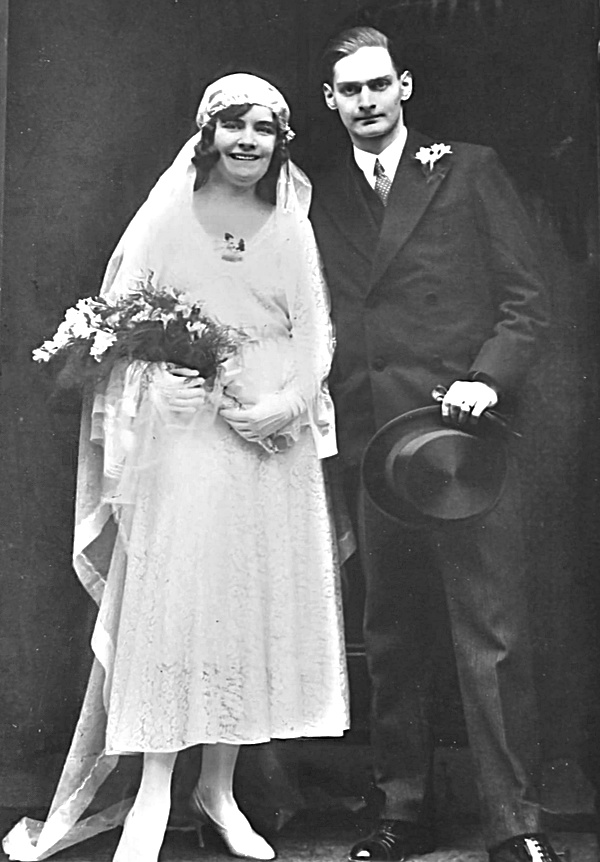
married couple
A married couple on the other side
It wasn’t easy for me to comply with the request to write a foreword to the memoirs of the legendary married couple who devoted their lives to that of the Indonesian people through their work – first because I had never met the couple in person, so I had had no chance to get to know them closely, and second because my knowledge of Wim Wertheim was largely confined to his writings, including Indonesian Society in Transition: A Study of Social Change (1964), published in Indonesian in 1999.
However, my interest in Wim Wertheim (1907-1998) grew stronger when I was researching the massacre of members and sympathisers of the Indonesian Communist Party (PKI) in the Grobogan regency in Central Java, while writing a thesis for the history department of the Faculty of Letters (now the Faculty of Cultural Studies) at the Diponegoro University in Semarang. One of my chapters looked specifically at the internationalisation of the affair, and Wertheim’s contribution to it. When I had finished writing, I sensed that something was still missing, and so I decided to find out more about Wim Wertheim’s role.
In winter 2007 I therefore travelled to Soest, a small town 37 kilometres south-east of Amsterdam, to meet the historian and activist Professor Jan Pluvier, author of the book Geschiedenis van de Indonesische Nationale Beweging 1930-1942 (‘History of the Indonesian National Movement 1930-1942’).
Together with Wim Wertheim and various other friends, including Slamet Faiman (an Indonesian sailor who lived in the Netherlands before the Second World War and was a member of the underground anti-Nazi movement), Pluvier had helped set up the Komitee Indonesia (‘Indonesia Committee’) which fiercely criticised the Suharto regime.
The Indonesia Committee was set up in 1969, four years after the G30S incident op 30 September 1965, which claimed numerous lives. Not only were army officers killed in the early morning of 1 October, but hundreds of thousands of members and sympathisers of the Indonesian Communist Party (PKI) and loyal supporters of the former president Sukarno were also killed during the events that followed.
I asked Pluvier in detail about the activities of the Indonesia Committee. The affair was widely reported in the Dutch media after Poncke Princen had invited two Dutch journalists, Henk Colb and Cees van Caspel from the newspaper De Haagsche Post, to visit Purwodadi to hear at first hand the story of the murder of a priest, Father Wignyosumarto. The priest Wignyo had previously heard the confession of Mamik, a member of the Civil Defence movement (Hanra), which killed nearly 50 people every night.
The news spread like wildfire in the Netherlands. On 27 February 1969 the newspaper Het Algemeen Dagblad published a report with the shocking title ‘Indonesian accuses own army of 3,000 murders’ or ‘An Indonesian accuses his army of being responsible for the murder of 3,000 people.’ The Indonesian in question was Poncke Princen, whose statement was referred to by the press.
In the Western world a massacre of left-wing politicians was good news in the two decades after the Second World War. The same applied to the Dutch government, whose relations with Indonesia had deteriorated during Sukarno’s rule. But to Wertheim, the 1965-1969 massacres were bad news that aroused his anger. He now set up the Indonesia Committee and soon organised a protest movement involving demonstrations, statements to the media and public meetings.
Wertheim’s criticisms were widely heard and had a great impact on the Dutch public, including students. On 17 April 1969 they organised demonstrations against the presence of members of President Suharto’s government on the campus of Nijmegen University, among them the Indonesian finance minister Frans Seda, who was booed by the students with cries of ‘murderer!’ and ‘coward!’ His visit to the Netherlands had been intended to normalise Dutch-Indonesian relations, frozen under the Sukarno regime. Some senior Indonesian officials were lobbying for investment (in other words, loans) from Western countries, including the Netherlands. The visit was also in preparation for President Suharto’s planned trip later the same year – but this was eventually postponed until 4 September 1970.
Wim Wertheim was opposed to the idea of restoring diplomatic relations, for he sensed that the offers of aid were part of a hidden agenda to recolonise Indonesia.
He was also critical of the Dutch government’s lack of response to the massacres. As he said in an interview, ‘we should not be collaborating with a mutinous junta that has killed so many innocent people.’ Both on behalf of the Indonesia Committee and personally he made many critical comments on the Suharto government’s policy. He was always aware of the general situation of the ordinary population and the question of justice in development, including the imprisonment of political opponents and the introduction of the death penalty in Indonesia. As a scientist, Wertheim did not stay in an ivory tower, but plunged into the arena and was directly involved in the process of finding out the truth about the problems in Indonesia, even though he could no longer visit his second homeland.
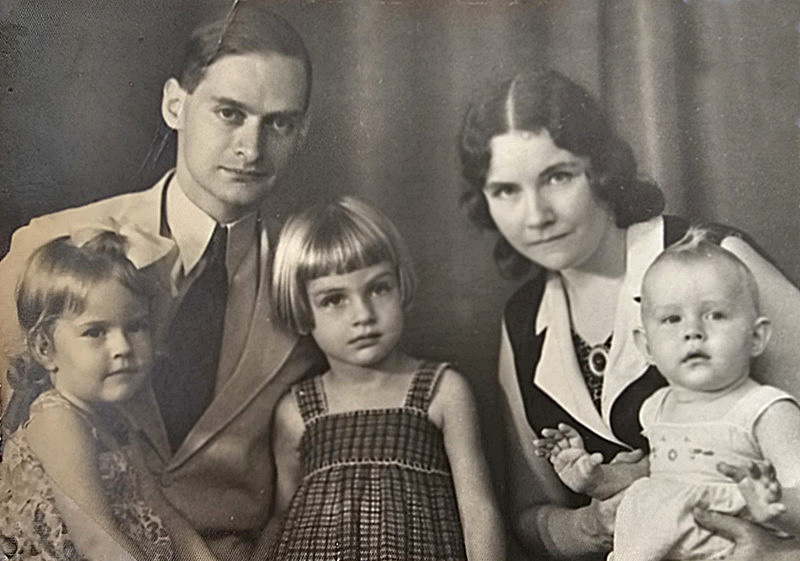
The family Wertheim
What made Wertheim the critical and courageous man we know him to have been?
Both Wim and his wife Hetty were born into well-to-do middle-class families. Wim’s father was the director of an insurance company, and his family had lived as expats in the Russian city of Saint Petersburg. Hetty’s father was the head of a prison in the Dutch town of Veenhuizen. With such family backgrounds, they undoubtedly had ample opportunity to live more stably. However, the fast-changing historical reality of the times made many changes to both their lives.
The couple’s lives were not easy, given the unavoidable realities. This book helps explain why. Their decision to emigrate to Indonesia finally meant that Suharto’s finance minister Frans Seda was forced to cancel his lecture marking the anniversary of Nijmegen University. But emigrating to Indonesia was not a choice to which Wertheim at first gave priority.
Wim did not come from a Dutch family that had been settled in Indonesia for many years. The colony was a distant country to him, which meant he had to learn everything about his new homeland. Max Havelaar was the first novel to which Wertheim turned. It seems to have been a trend among Dutch people who went to work in Indonesia to read the novel first as a source of information. When Henk Sneevliet was planning to move to Indonesia in 1913, he also read Max Havelaar. Although Wertheim felt that the novel by Multatuli (Eduard Douwes Dekker’s pen name) did not provide enough of the information he needed, it did help him understand something of the situation in Indonesia before he arrived there.
As the title of the book ‘Four turning points in our lives’ makes clear, Wim and Hetty’s lives were full of unavoidable surprises. As a child, Hetty had to move from the town of Veenhuizen to the city of Leiden and then to the coastal resort of Scheveningen, where she was unnerved by the frills and flounces of the modern world: the telegraph cables hanging along the railway lines, and the glittering lights and candles marking the birth of Queen Wilhelmina’s daughter Juliana. Hetty sensed a distance between her family and her maternal grandparents’ family, because of the difference in social status between her mother and her father. Her mother’s brothers were doctors, lawyers and company directors, whereas her father was only a prison director. Aside from a small child’s subjective ideas, this is of course an interesting view, for it shows that distinctions in social caste can be found everywhere. Even though the Netherlands was one of the imperialist colonial powers, that did not mean there were no sharp class divisions within its own society.
Dutch society then mostly consisted of workers and farmers and a tiny commercial and ruling elite. White Dutch people usually only experienced a change of class when they arrived in Indonesia. As white Dutch masters and mistresses, however hard their lives in the Netherlands might have been, they acquired a higher status in the colony simply because of their physical features. Wim candidly mentioned this when describing his first experience on the voyage out to Indonesia, when the superiority of the white race overshadowed all class categories – even the class distinctions that had prevailed back in the Netherlands no longer applied.
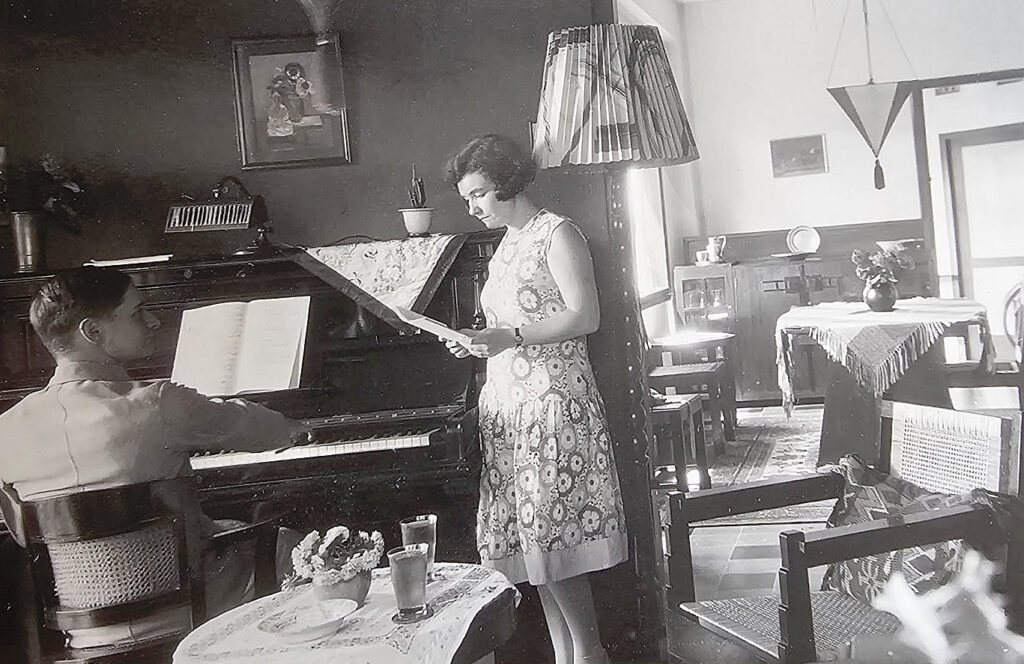
making music
‘That first journey to Indonesia was astonishing! We were suddenly transplanted from everyday Dutch life to a life of luxury. Food in abundance, extravagant parties, and there were always slaves who were submissive and almost subjugated... At the same time, the class differences back in the Netherlands, the very real differences between the “upper” and “lower” classes, seemed to have been erased among the Europeans on board ship...’ Class boundaries disappeared simply because of entrenched racism. In the European class system you could still move from one class to another. But the racial boundaries were inherent in skin colour, and Wim described what he felt when he saw this unfair inequality.
This was the second turning point in Wim and Hetty’s lives. The newly-wed couple ‘plunged into the dark’ to try their luck in a colony. Later, in the third and fourth turning points in their lives, they again had depressing experiences.
Reading Wim and Hetty’s stories, it is hard to imagine how the couple, born into middle-class families, could venture into a distant country that had been ruled by the Netherlands for centuries. The colonial society with its racial, ethnic and class inequalities opened their eyes, and they chose to side with the oppressed. Nor was Wim’s choice to do so just a formality enabling him to make colonial matters the subject of his critical sociological studies. Another reason was his own experience – for he had been in a similar situation when he found himself in an internment camp during the Japanese occupation.
His personal encounter with the situation in the colony proved more valuable than the knowledge he had acquired at university. As a couple who were well aware of the situation in the colony, Wim and Hetty showed that their traumatic experience did not have to lead to a gloomy, apathetic attitude. Wim increasingly opposed the prevailing views, and Hetty joined him. As the sociologist Jan Breman said of his teacher, ‘Wertheim deliberately chose to be a whistle-blower.’ The results of this choice were that they lost many friends and their list of enemies lengthened. The initially a-political Wim became a politically conscious intellectual who even fought for his political convictions: defending the oppressed, and justice for all. The couple increasingly dared to take a stand on the other side.
It may be hoped this book will be a work of reference for intellectuals who often get stuck in the grey area because of their self-image and personal comfort.